Different Types of Sailboats: A Complete Guide
All the different types of sailboats explained — from sloops and cutters to ketches, yawls, and schooners. Learn the three ways sailing boats are classified (rig, hull, and keel) with real examples from our database of 5,000+ production sailboats.
How Sailboats Are Classified
When we talk about types of sailboats, we're really discussing three independent classification systems that describe how a boat is rigged, hulled, and keeled. Understanding these distinctions is essential whether you're a buyer, sailor, or simply curious about the incredible diversity of sailboat design.
The first classification system focuses on rig type — the arrangement of masts and sails. A sloop has one mast; a cutter has one mast with two headsails; a ketch has two masts with the rear mast forward of the rudder. These distinctions affect sailing balance, performance, and how easy a boat is to handle.
The second system covers hull type: monohull (one hull), catamaran (two hulls), or trimaran (three hulls). This choice determines stability, interior space, beaching capability, and speed characteristics.
The third system describes keel type — the underwater fin(s) that provide directional stability and reduce leeway. Full keels, fin keels, wing keels, centerboards, and bulb keels each offer different compromises between draft, directional stability, and performance.
Most boats are classified by rig type first (e.g., "a Catalina 30 sloop"), then by hull type (all Catalinas are monohulls) and keel type as distinguishing variants (wing vs. fin keel).
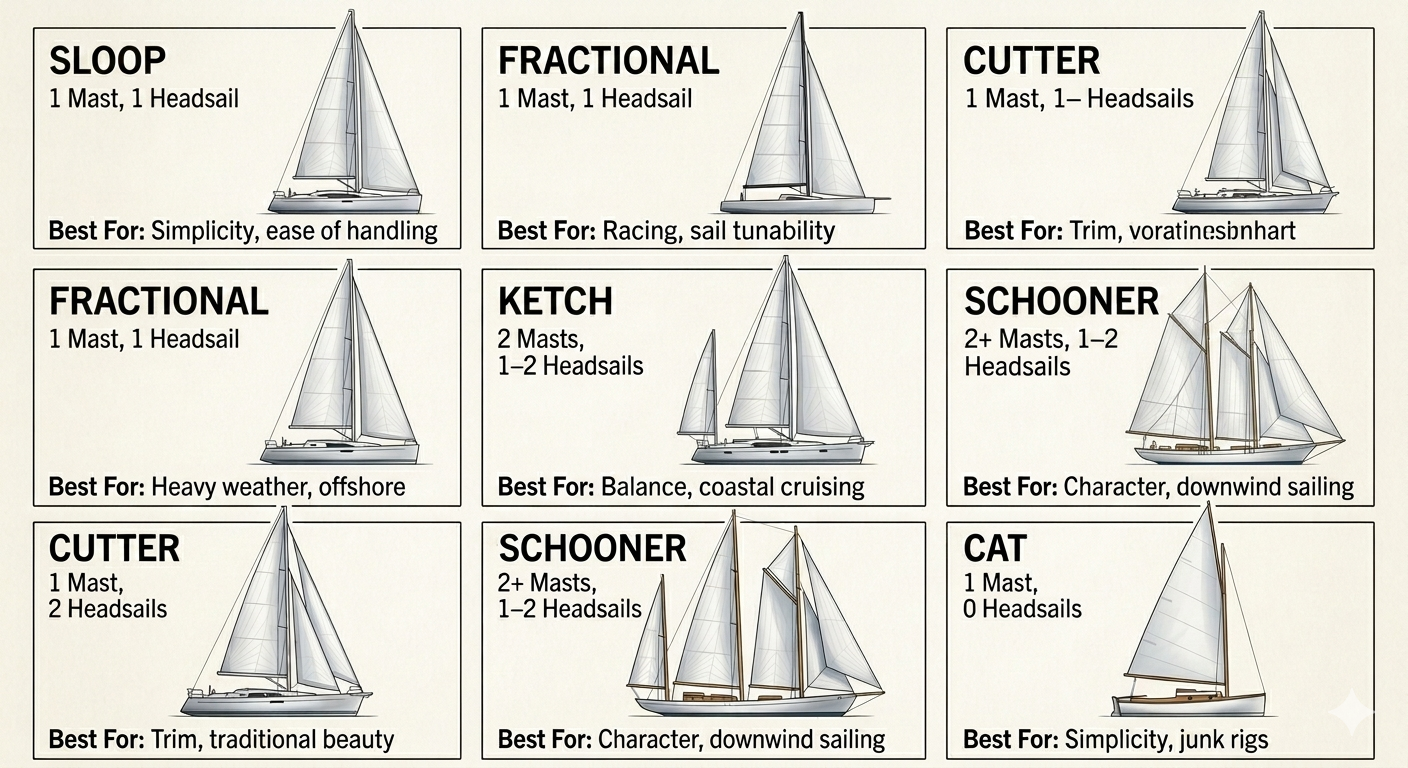
Quick Rig Comparison
| Rig Type | Masts | Headsails | Best For |
|---|---|---|---|
| Sloop | 1 | 1 | Simplicity, ease of handling |
| Fractional Sloop | 1 | 1 | Racing, sail tunability |
| Cutter | 1 | 2 | Heavy weather, offshore |
| Ketch | 2 | 1–2 | Balance, coastal cruising |
| Yawl | 2 | 1–2 | Trim, traditional beauty |
| Schooner | 2+ | 1–2 | Character, downwind sailing |
| Cat | 1 | 0 | Simplicity, junk rigs |
Sailboat Rig Types
Rig type is the primary way sailors identify boats. It describes how the masts and sails are arranged, which fundamentally affects how a boat performs and feels under sail. Let's explore the major types of sailboats based on their rigging configurations.
Sloop
The sloop is the dominant rig in modern sailing. It consists of a single mast with one headsail (jib) set forward of the mast and a mainsail aft. This simple configuration accounts for roughly 70% of all cruising sailboats worldwide.
Sloops are beloved for their simplicity: fewer lines to manage, easier sail changes, and straightforward balance. They're efficient on all points of sail and respond intuitively to helm input. For a monohull sailboat designed for cruising, the sloop rig is the default choice — it's affordable, proven, and forgiving.
Classic examples include the Catalina 22, Catalina 30, Hunter 27, and Catalina 34. Each represents a different size class, but all share the simple, effective sloop configuration.
Fractional Sloop
A fractional sloop (or "7/8 sloop") is a performance variant where the forestay attaches partway down the mast rather than at the very top. This reduces the size of the jib and allows the mainsail to be taller and more powerful, improving speed and pointing ability.
Fractional rigs are common in racing and high-performance cruisers because they offer greater sail tuning control and better upwind performance. The trade-off is slightly increased complexity — you're managing two sail sizes that interact differently under various wind conditions.
The J/30 and J/35 are iconic fractional sloop racers, as are many C&C 30 designs. Performance cruisers like these prioritize speed without sacrificing cruising comfort.
Cutter
A cutter resembles a sloop but with a critical difference: it carries two headsails — a staysail (set closer to the mast) and a yankee (a smaller jib forward of the staysail). This dual-headsail configuration gives cutters unmatched flexibility in changing wind conditions.
Cutters are the choice of bluewater cruisers and offshore adventurers. In moderate winds, both headsails work together for power. In heavy weather, you drop the yankee and sail under staysail and mainsail alone — a much smaller total sail area that's easier to manage in rough seas. This flexibility made cutters legendary during the Age of Sail and keeps them relevant for modern ocean voyaging.
Cutter examples include the Pacific Seacraft 34, Westsail 32, and Cape Dory 36 — all rugged, heavily built displacement boats optimized for long-distance cruising. If you're planning an ocean passage, a cutter offers the versatility that can save your boat in a gale.
Ketch
A ketch features two masts: a main mast forward and a shorter mizzen mast positioned forward of the rudder post. The mizzen sail provides significant propulsive power, not just balance. This configuration offers a useful sail plan for cruising — you can drop the main in heavy weather and sail under jib and mizzen alone.
Ketches look traditional and handle beautifully. The two masts distribute weight and create visual balance. Under sail, a well-trimmed ketch feels alive — the mizzen responds to helm adjustments and actively helps drive the boat forward. Ketches were the workhorses of commercial fishing and cruising for decades, and many sailors still prefer their balanced feel to the more utilitarian sloop.
Notable ketch cruisers include the Tayana 37 and various Irwin and Whitby models. These are displacement cruisers that reward patient sailing with a smooth, forgiving motion and an almost yacht-like quality to their handling.
Yawl
A yawl is often confused with a ketch, but the difference is crucial: the mizzen mast is positioned aft of the rudder post, not forward of it. This placement means the mizzen contributes little to propulsion — it's primarily a trim and balance sail. In practice, dropping the jib allows you to sail under main and mizzen, but the mizzen does minimal work.
Yawls are chosen more for aesthetics and tradition than for sailing efficiency. They're elegant, historically significant (many classic yachts were yawls), and handle with a certain gentleness. The mizzen can help balance helm and reduce weather helm in some designs, and it looks undeniably beautiful from the dock or in photographs.
The Hinckley Bermuda 40 is an iconic yawl, as is the Allied Luders 33. These are boats that attract serious sailors who value heritage, refinement, and that indefinable quality called "yacht-iness."
Schooner
A schooner has two or more masts with the foremast distinctly shorter than the main mast. This arrangement is relatively rare in modern production boats but iconic in tradition and character. Schooners excel on downwind points of sail and have a romantic, classic appearance that appeals to traditionalists.
The schooner rig was the dominant design for fishing vessels and trading ships in the Age of Sail because it was efficient to windward and easy to handle by a small crew. Modern schooners are typically one-off or small-batch custom builds, often incorporating junk rigs or unconventional sail plans.
Schooner examples are rarer in modern production databases, but Freedom 33 (which exists in a schooner variant) represents the modern approach to this classic rig — unconventional, efficient, and full of character.
Cat Rig
A cat rig (or catboat) has a single mast with no headsail — just a main sail. The mast is typically positioned far forward on the boat, and a large, high-aspect-ratio mainsail does all the work. This radical simplicity makes cat rigs ideal for small daysailers, trailerable boats, and modern high-tech designs.
The appeal is obvious: one sail, one halyard, no jib sheet to adjust. Modern cat rigs, often using battens or junk sail configurations, reduce weight and crew burden. Older catboat traditions (like the Nonsuch 30) used gaff-rigged mains that looked enormous but were actually quite manageable.
Examples include Nonsuch designs, Com-Pac 16 (a small trailerable cat), and various junk-rigged custom builds. For someone who sails solo or wants to minimize complexity, a cat rig is the ultimate expression of sailing simplicity.
Gaff Rig
A gaff rig is a traditional sail shape where the upper edge of the mainsail is supported by a gaff — a spar extending aft and upward from the mast. This creates a distinctive tall, rectangular sail shape that looks stately and powerful. Gaff rigs were standard on commercial and military vessels for centuries and remain popular in classic and traditional designs.
Gaff sails have several advantages: they're efficient even at larger angles of attack (useful for downwind sailing), they're forgiving in heavy air, and they look undeniably beautiful. The main downsides are the additional complexity of the gaff itself and the need for strong crew to manage the peak of the sail.
Gaff-rigged boats are typically found in classic or custom builds. Marshall Sanderling catboats and traditional Herreshoff-inspired designs feature gaff rigs. The Montgomery 17 also uses a gaff configuration. If you're drawn to heritage sailing and don't mind the gear complexity, a gaff rig offers a connection to sailing's romantic past.
Hull Types
Hull type describes the fundamental shape of the boat — how many hulls it has and how they're arranged. While rig type gets most of the attention among sailors, hull type is equally important for understanding a boat's capabilities and character.
Monohull
A monohull is a boat with a single hull — the vast majority of sailboats ever built. Every boat in the Keel Index database of 5,000+ boats is a monohull (we focus on single-hull designs).
Monohulls come in two broad categories: displacement hulls and planing hulls. Displacement hulls move water out of the way, creating a wave system, and are limited in speed by the hull's length (the "hull speed" formula). Planing hulls, with their flatter bottoms and higher power-to-weight ratios, can literally climb over the water surface and exceed theoretical hull speed. Most cruising sailboats are displacement designs, while racing machines and high-performance motorboats use planing hulls.
Monohulls offer the best cargo capacity relative to weight, they're intuitive to maneuver, and they're easier to maintain and repair than multi-hull vessels. They heels over when you sail hard, which some sailors love and others find uncomfortable — but that heel is a fundamental part of monohull sailing dynamics.
Catamaran
A catamaran has two parallel hulls connected by beams or a common deck. This configuration offers tremendous stability (they don't heel), larger deck space, and impressive shallow-draft capabilities. Many modern cruising catamarans plane more easily than equivalent monohulls, producing faster passage times.
The tradeoffs are increased width (mooring and marina constraints), higher construction costs, and a less responsive feel under sail compared to a heeling monohull. However, for cruising sailors who prioritize comfort, spacious accommodations, and stable deck standing room, catamarans have become increasingly popular over the past 20 years.
Keel Index focuses on monohull designs because that's where the bulk of the classic and modern production sailboat database lives, but catamarans represent a growing segment of the sailing market.
Trimaran
A trimaran features a main central hull with two smaller outrigger hulls (called amas) on either side. This configuration provides exceptional stability while remaining relatively narrow, offering a compromise between monohull and catamaran characteristics. Trimarans are fast, stable, and have a narrow beam for marina access.
Trimarans are rare in cruising because they're expensive to build and maintain, and the amas can complicate docking and maneuvering in tight spaces. They're most common in racing designs and experimental high-performance cruisers. The engineering and sailing dynamics of trimarans are fascinating but beyond the scope of a basic sailboat types guide.
Keel Types
The keel is the underwater fin that provides directional stability and resists leeway (sideways slipping when sailing to windward). Keel type is one of the most significant design choices affecting how a boat sails, what draft it has, and what waters it can navigate.
Full Keel
A full keel extends from the stem (front of the boat) to the sternpost (rear), creating a continuous deep fin. Full-keeled boats offer maximum directional stability — they're extremely easy to steer straight and naturally self-correcting. They're slow to turn and require deliberate helm input, but they're nearly impossible to accidentally jibe or lose control.
Full keels are characteristic of displacement cruisers and offshore boats built to survive heavy weather and ocean passages. The continuous keel protects the rudder from damage (critical when running aground in remote areas), and the high wetted surface and deep draft provide excellent holding power.
Classic full-keel examples include the Westsail 32, Pacific Seacraft 34, Bristol 32, and Cape Dory 25. These boats often weigh 30,000–50,000 lbs and are optimized for cruising comfort, not racing speed.
Fin Keel
A fin keel is a separate, relatively short underwater fin attached to the bottom of the hull. Modern racing and performance cruisers almost universally use fin keels because they offer excellent maneuverability, reduced wetted surface (less drag), and the lowest possible displacement for a given boat size.
Fin keels are less directionally stable than full keels — they require more active steering and some boats can develop a "twitchy" helm. However, they turn tightly, accelerate quickly, and are faster to windward. The trade-off is that fin-keeled boats often heel more dramatically and feel more athletic under sail.
The Catalina 30, Hunter 34, and J/30 are all modern fin-keeled designs that balance performance with cruising comfort. These boats are responsive, fun to sail, and accessible to both racing and cruising sailors.
Wing Keel
A wing keel is a specialized fin keel with small "wings" — horizontal extensions — attached near the bottom. These wings create additional lateral force (lift) without requiring additional draft, reducing the minimum water depth a boat can navigate while maintaining performance.
Wing keels were innovative solutions for boats that needed to access shallow harbors and rivers without sacrificing sailing performance. The Catalina 22 wing keel variant is popular precisely because it allows a boat designed for 6-foot draft to operate in 5-foot waters.
Wing keels are less common now that designers have become more skilled at optimizing fin keel shapes, but they remain relevant for cruisers prioritizing shallow-water access. They're also prone to picking up seaweed in some conditions — the wing extensions catch more debris than a simple fin.
Centerboard & Swing Keel
A centerboard (or daggerboard) is a keel that retracts vertically into a slot in the hull. A swing keel pivots like a door, rotating up into the boat. Both allow shallow-draft sailing — you can beach the boat, access rivers, and trailer the boat to different sailing areas.
The trade-off is complexity: centerboard and swing keel mechanisms require maintenance, they can jam with sand or weed, and they add weight to the boat. However, for sailors who want to explore shallow backwaters or need a trailerable boat, these solutions are invaluable.
Popular retractable-keel boats include the Catalina 22 (available in swing-keel variant), MacGregor 26 (power-retractable), and O'Day 22. These boats democratize sailing by fitting into a standard 6-foot-wide boat slip or behind a pickup truck.
Bulb Keel
A bulb keel is a fin keel with a weighted bulb at the bottom, typically containing lead or iron. This design lowers the boat's center of gravity dramatically, reducing heeling and improving righting moment (the boat's ability to recover from a knock-down). Bulb keels are standard on racing yachts and high-performance cruisers.
The downside is cost: bulb keels are expensive to manufacture and require precise weight distribution. They also suffer durability concerns if the boat is grounded and the bulb breaks off. For racing and dedicated performance cruisers, though, the performance advantage justifies the investment.
Bilge Keel
A bilge keel consists of two parallel fins, one on each side of the hull at the turn of the bilge (the curved transition from bottom to side). Bilge keels reduce heeling, allow the boat to "dry out" upright when beached (it doesn't roll onto its side), and reduce windage.
Bilge keels are traditional in British yacht design and are common in European cruisers. They're losing popularity in modern design because fin keels have become so refined, but they remain a sensible choice for traditional or gaff-rigged boats that will be beached or left high and dry in tidal areas.
Sailboat Categories by Use
Beyond rig and hull and keel, sailboats are often described by their intended use. These functional categories overlap with technical classifications but offer a practical way to think about what a boat is designed to do.
Daysailer
A daysailer is optimized for afternoon sailing trips — typically 4–8 hours on the water. Daysailers have minimal or no cabin space, focusing instead on deck space, simplicity, and trailering capability. They're often small (15–25 feet), lightweight, and designed for easy launching and recovery.
Examples include Precision 18, Montgomery 17, West Wight Potter 19, and Com-Pac 16. These boats are perfect for learning, weekend fun, and single-handed sailing. They emphasize sea-kindliness and safety over accommodation. See our guide to the best trailerable sailboats for detailed reviews of these designs.
Coastal Cruiser
A coastal cruiser is the workhorse of recreational sailing. With comfortable cabin, galley, and head facilities, coastal cruisers are designed for weekend trips and week-long vacations in protected and semi-protected waters. They typically range from 25–35 feet and balance performance, comfort, and ease of handling.
The Catalina 30, Hunter 27, Pearson 30, and Ericson 27 are quintessential coastal cruisers. They're the most popular and numerous class of sailboat because they offer genuine comfort without requiring a large crew or deep technical knowledge to sail. Our best sailboats for beginners guide covers many boats in this category.
Offshore & Bluewater Cruiser
Offshore cruisers are built for ocean passages and extended voyaging in all weather conditions. These boats prioritize robustness, safety, and self-sufficiency over speed or glamour. They have heavily built hulls, full keels, cutter rigs, and extensive cruising systems (water makers, multiple redundant power systems, robust sea anchors).
Classic offshore cruisers include the Pacific Seacraft 34, Westsail 32, and Cape Dory 36. These boats cost more to build and maintain, but they're the ones trusted for circumnavigations and Arctic exploration. If you're reading about bluewater sailboats, this is the category you're investigating.
Racer/Cruiser
A racer/cruiser balances performance and livability. These boats are built for weekend racing and extended cruising, using lightweight construction, modern rigging, and efficient sail plans. They're fast and fun to sail but retain cabins, galleys, and heads for overnight comfort.
Examples include J/30, J/35, C&C 30, and C&C 34. These are boats for sailors who want both speed and shelter, who enjoy racing but also take week-long cruises.
Liveaboard
Liveaboard cruisers are full-time homes afloat. They prioritize spacious accommodation, robust systems, and comfort over performance. Liveaboard boats are typically 35+ feet, with large galleys, separate cabins, and systems redundancy (dual engines, multiple generators, comprehensive water and fuel capacity).
These boats are designed for people who will spend months or years at sea. Read more in our guide to liveaboard sailboats for detailed information on systems, costs, and the liveaboard lifestyle.
How to Choose Your First Sailboat Type
Understanding sailboat types is the first step toward finding the right boat for your sailing goals. Here's a practical decision framework:
Decision Guide
- First-time sailors & daysailing: Choose a small (under 25 ft) sloop daysailer with a centerboard or swing keel. Examples: Catalina 22, Com-Pac 16, O'Day 22.
- Weekend cruising (protected waters): Look for a 25–32 ft sloop coastal cruiser with a fin keel. Examples: Catalina 30, Hunter 27, Pearson 30.
- Longer coastal trips & some offshore: Consider a 30–37 ft cutter or dual-purpose ketch with a full or deep fin keel. Examples: Pacific Seacraft 34, Tayana 37, Cape Dory 36.
- Extended liveaboard cruising: Look for a 35+ ft cutter or ketch with proven offshore pedigree and systems redundancy. Examples: Westsail 32, Tayana 37.
- Racing & performance sailing: Choose a fractional sloop racer/cruiser with a fin or bulb keel. Examples: J/30, C&C 30.
- Trailering & flexibility: Prioritize centerboard or swing keel designs. Examples: Catalina 22 swing, MacGregor 26.
Once you've narrowed down your use case and preferred type, use Keel Index to compare specific boats. Our comparison tool lets you line up detailed specs, performance data, and pricing across different models. Visit the complete boat database to explore thousands of production sailboats and read detailed specifications for your top candidates.
Explore Every Type
Now that you understand the major types, browse detailed specs, performance data, and current market prices for 5,000+ production sailboats.
Browse All Sailboats → Compare Sailboats →