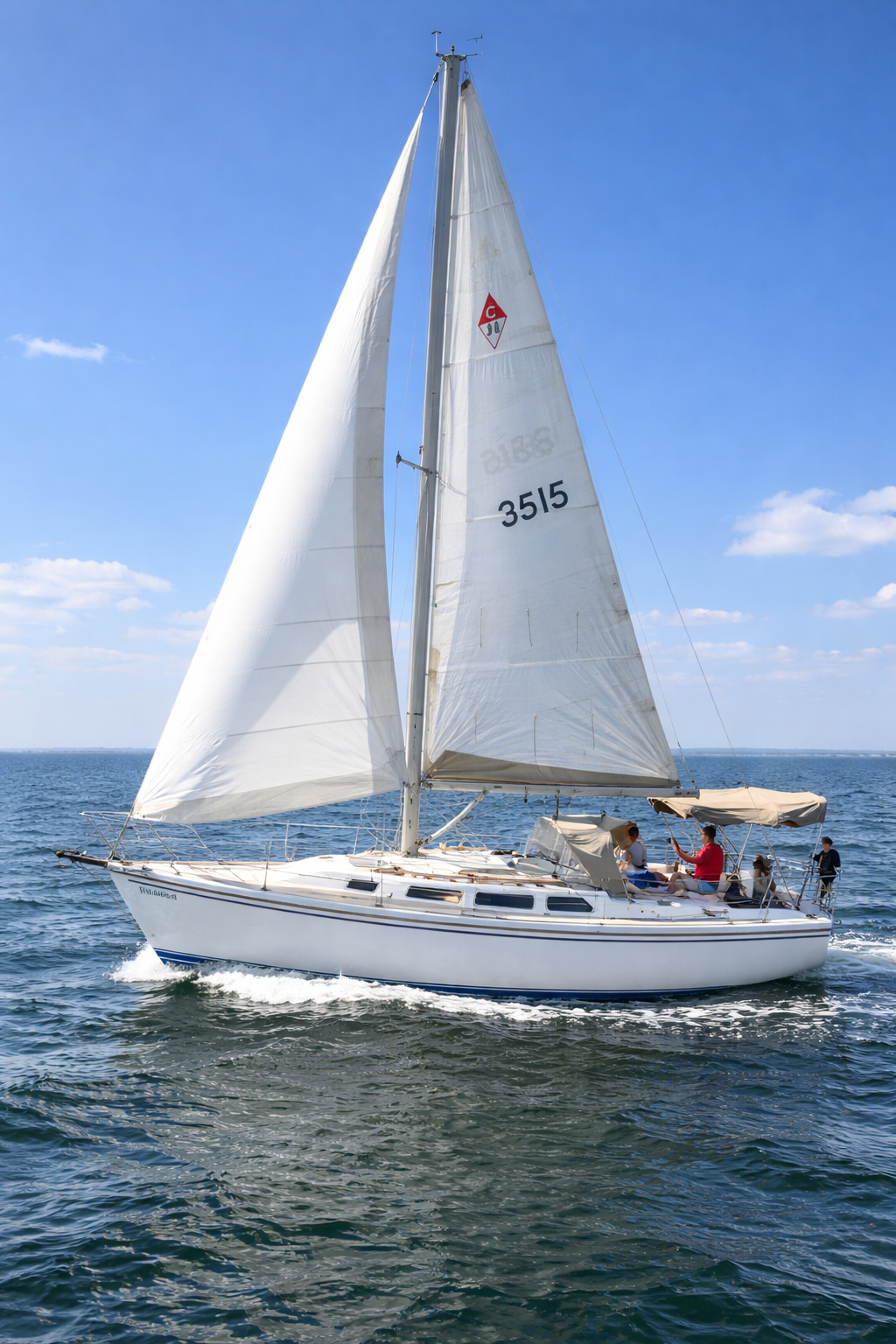
First launched in 1976 and remaining in production until 2008, Frank Butler's Catalina 30 became one of America's most successful mid-size cruising sailboats, with over 6,400 hulls built during its impressive 32-year run. This popularity stems from Butler's thoughtful design that balances affordability, comfort, and solid sailing performance. The Catalina 30's moderate displacement of 10,200 pounds and generous beam of 10.83 feet create a stable, roomy platform ideal for coastal cruising and weekend adventures. With 446 square feet of sail area driving the masthead sloop rig, the boat offers respectable performance while remaining manageable for couples or small crews. The fin keel and spade rudder configuration provides good maneuverability and pointing ability. Butler designed the hull with a comfortable motion and predictable handling characteristics that inspire confidence in new sailors while still satisfying more experienced crews. The boat's construction quality and parts availability remain excellent thanks to Catalina Yachts' continued support. While primarily suited for coastal and protected water sailing, many owners have successfully completed longer passages, making the Catalina 30 a versatile choice for sailors seeking reliable performance without breaking the budget.
About this estimate ▾
- Based on asking prices — not actual sale prices, which are typically lower.
- Condition, year, location, and included equipment are not factored in.
- Outliers are automatically excluded using statistical filtering.
- See our full analysis: What Thousands of Sailboat Listings Tell Us About Used Boat Prices.


No owner reviews yet — be the first to share your experience with this boat.
What's the difference between a Catalina 30 MkI, MkII, and MkIII?
Catalina 30 production spanned three major revisions between 1972 and 2008. The MkI (1972 through the mid-1980s) has the original flat transom, an Atomic 4 gasoline engine as the factory standard on earlier hulls, and the traditional interior layout. The MkII (introduced 1986) kept the same flat transom but standardized on the Universal M25 diesel and updated the interior joinery and galley. The MkIII (introduced 1994) is the easiest to spot visually — it has the reverse transom with an integrated walk-through swim platform, plus a redesigned interior, optional wing keel, and the later M25XP or M35 diesel. All three share the same Frank Butler-designed hull form, so sailing performance is broadly similar; the choice between them usually comes down to engine, swim-platform preference, and price.
Where is the water pump on a Catalina 30?
On the Universal M25 and M25XP diesel (the standard engine from 1986 through the end of MkII and most of the MkIII production), the raw-water pump is mounted on the front of the engine block on the port side. Access it by removing the companionway steps, which exposes the full front face of the engine. The fresh-water circulating pump sits higher and further back, behind the alternator. On earlier MkI hulls fitted with the Atomic 4 gasoline engine (1972 through roughly 1983), the raw-water pump is belt-driven off the front of the engine in a similar location, but the impeller is a smaller Jabsco unit and service intervals are shorter. Both engines share the same access path through the companionway steps.
Is a Catalina 30 a bluewater boat?
Not by design. The Catalina 30 was drawn as a coastal cruiser and weekender for protected waters and short coastal passages. Its Capsize Screening Formula value is close to 2.0 (the generally accepted threshold for acceptable offshore performance), its comfort ratio is around 25 (which is lower than what most offshore sailors want for extended passages), and the standard rigging, tankage, and hull-to-deck joint were not built for sustained offshore loads. That said, Catalina 30s have crossed oceans and completed long passages — owners have sailed them to Hawaii, down to the Caribbean, and across the Atlantic — but those boats were heavily modified with upgraded rigging, additional tankage, storm canvas, and careful weather routing. As a stock boat off the used market, it's best suited to lakes, bays, the Intracoastal, and coastal hops in settled weather.
How many Catalina 30s were built?
Catalina Yachts built more than 6,200 Catalina 30s between 1972 and 2008, making it one of the most-produced 30-foot sailboats in history and the best-selling boat in the Catalina line for most of its run. The high production volume is why the used-boat market for a Catalina 30 is so deep — there are typically dozens of active listings at any given time across Craigslist, YachtWorld, and regional sites, and parts, upgrades, and owner knowledge are widely available. The Catalina 30 International Association (C30IA) is still active and maintains hull-number registries, technical notes, and regional fleets.
What are the most common problems to watch for on a used Catalina 30?
The recurring issues buyers find on inspection are the galvanized-steel fuel tank (original tanks are now 30+ years old and prone to perforation from the inside out — many owners have replaced them with aluminum or polyethylene), hull-to-deck joint leaks around the chainplates and stanchion bases (signaled by water streaks inside lockers and around the main bulkhead), iron keel rust and weeping on earlier hulls (cast-iron keel was standard; the lead-keel option came later), Universal M25 head-gasket failures from raw-water overheats, and soft spots in the cockpit sole on boats that have lived in rain-heavy climates. None are deal-breakers on their own, but the combination is why a pre-purchase survey by a SAMS- or NAMS-accredited surveyor is the single best money spent before closing. The full list with severity ratings is on the Issues tab for this boat.