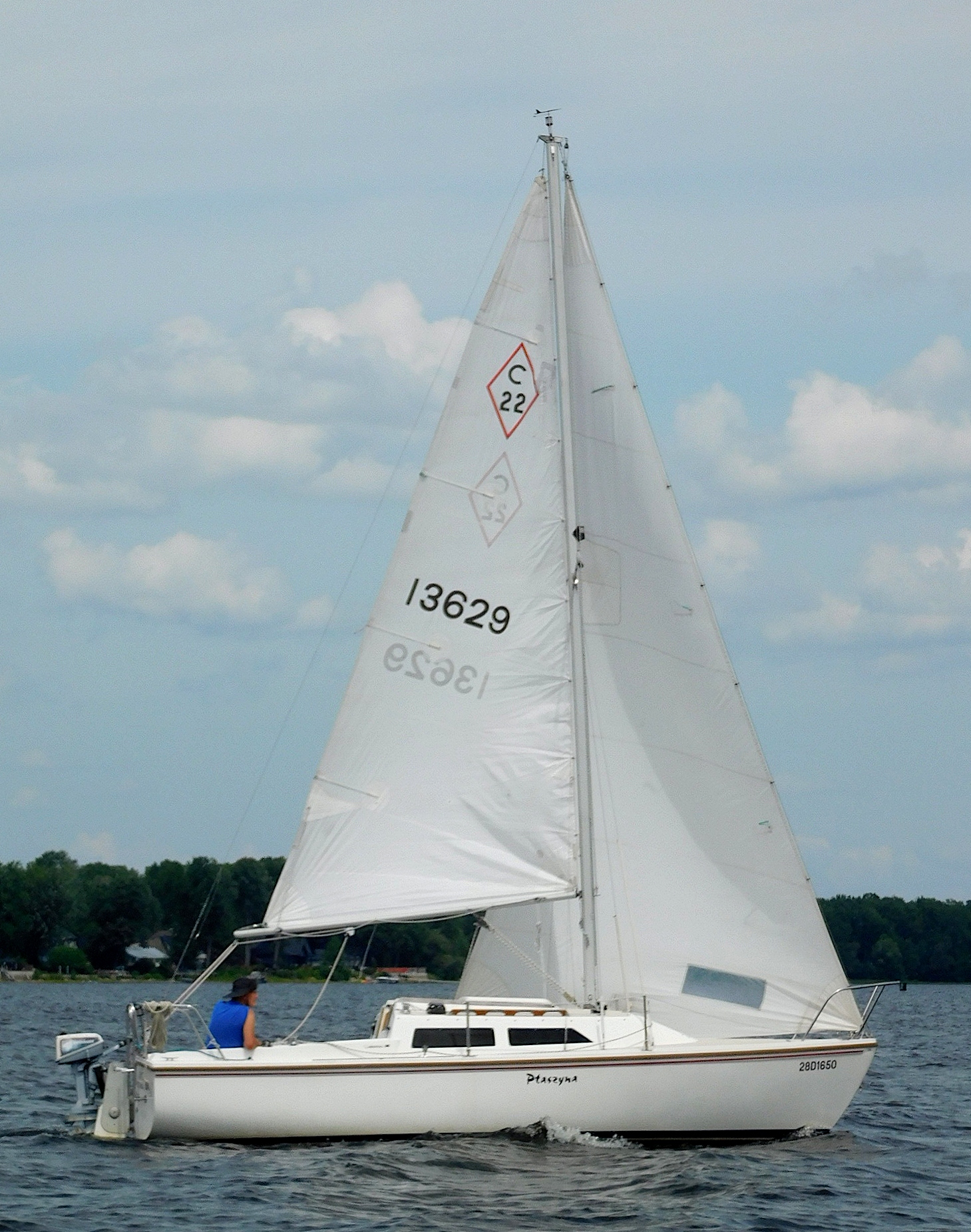
First launched in 1969 and designed by Frank V. Butler, this popular small cruiser has earned its place as one of America's most successful sailboat designs, with over 15,000 hulls produced by Catalina Yachts. The swing keel configuration is the boat's defining feature, allowing the draft to retract for shallow water exploration and easy trailering, making it exceptionally versatile for weekend sailors. With its masthead sloop rig and 212 square feet of sail area driving a displacement of 2,250 pounds, the Catalina 22 offers respectable performance for coastal cruising and daysailing. The swing keel design, while sacrificing some upwind performance compared to fixed-keel boats, opens up countless shallow anchorages and launch ramps that deeper-draft vessels cannot access. The fiberglass construction has proven durable over five decades, and the boat's moderate beam of 7.67 feet provides reasonable interior space while maintaining trailerable width. Its comfortable cockpit accommodates a small crew nicely, and the cabin offers basic overnight accommodations for two adults. Best suited for protected coastal waters, lakes, and bays, this design remains popular among new sailors and those seeking an affordable entry into cruising sailboats that can be easily transported and launched.
About this estimate ▾
- Based on asking prices — not actual sale prices, which are typically lower.
- Condition, year, location, and included equipment are not factored in.
- Outliers are automatically excluded using statistical filtering.
- See our full analysis: What Thousands of Sailboat Listings Tell Us About Used Boat Prices.


No owner reviews yet — be the first to share your experience with this boat.
What's the difference between a Catalina 22 MkI, MkII, and Sport?
The original Catalina 22 (the MkI, 1969–1995) is the boat most sailors picture when they hear the name — 23.83 feet overall, 2,250 pounds displacement, swing keel as the standard configuration, and more than 15,000 hulls built across the run. The Catalina 22 MkII (1995–2015) kept the same hull dimensions but redesigned the interior with more headroom, added larger opening ports and a cleaner bulkhead arrangement, moved the companionway offset, and revised the deck layout with recessed hardware. The Catalina 22 Sport (2004–2015, with intermittent production) is effectively a stripped-down MkI hull with a simplified keel (fixed shoal-draft or retractable) aimed at daysailing and one-design racing rather than weekending. All three trailer with a mast-raising system and sail under a masthead sloop rig — the choice between them usually comes down to year, price, and whether you want the MkII's improved interior.
What does a Catalina 22 weigh?
A Catalina 22 has a displacement of 2,250 pounds — that's the boat in fully-rigged sailing trim, including the 550-pound cast iron swing keel, standard rigging, and the cabin top. A trailer adds roughly 600 to 900 pounds depending on the axle and whether it's a roller or bunk design, which puts the trailer-plus-boat tow weight around 3,000 to 3,200 pounds — comfortably within the towing capacity of a V6 mid-size SUV or a half-ton pickup. The 550-pound keel alone is about 24% of the boat's total displacement, which is a high ballast ratio for a 22-footer and the reason the Catalina 22 is noticeably more stable under sail than most trailerable boats its size.
Swing keel vs fixed keel vs wing keel — which Catalina 22 is right for me?
Swing keel (factory default on most MkI hulls): pivots up into a trunk in the bilge, giving a 2-foot draft with the keel up for trailering and a 5-foot draft with the keel down for sailing. Best choice if you're trailering frequently or sailing in shallow waters. The factory keel-pivot cable and winch need periodic inspection — a frozen winch or corroded cable is the single most common repair on older swing-keel Catalina 22s. Fixed fin keel (a factory option): deeper draft, slightly better upwind performance, but you lose shallow-water access and trailering the boat becomes significantly harder. Wing keel (late MkI and MkII): fixed 2.5-foot draft with a horizontal wing at the bottom of the keel for ballast stability — splits the difference between swing and fin. Easiest to maintain (no cable, no pivot), only modestly less capable upwind than the swing or fin versions.
Can you trailer a Catalina 22?
Yes — the Catalina 22 was designed from the start to be trailered, and the combination of a 7.67-foot beam (well under the 8.5-foot legal limit in all US states without a wide-load permit), 2,250-pound displacement, and the retractable swing keel make it one of the most-trailered 22-foot sailboats ever built. A stock trailer puts the full rig around 3,000 to 3,200 pounds, which any V6 mid-size SUV or half-ton pickup can handle easily. The boat rigs in about 45 minutes with a mast-raising system installed, or roughly 90 minutes without. Most owners keep their C22 on the trailer at home and launch at public ramps — the 2-foot keel-up draft means most concrete ramps work without special equipment. For long-distance trailering, make sure the swing keel is pinned up and the cable is secured so it can't drop on a bump.
What are common problems to watch for on a used Catalina 22?
The single most important check is the swing-keel cable and pivot pin — if the cable is corroded or the pivot is seized, the keel can't be raised for trailering and replacement is a several-hundred-dollar job with the boat on its side. Second, check the hull-to-deck joint at the bow for stress cracks from trailering bumps — Catalinas of this era have a mechanical fastener joint rather than a glassed joint, and years of vibration can open it up. Third, inspect the cabin-top non-skid for soft spots (water intrusion into the deck core) and the chainplate bedding for leaks (they sit on the cabin-top, not the hull). Fourth, pop-top gaskets on MkI boats flatten over time and leak in rain. None of these are deal-breakers on their own — all have well-documented fixes on the Catalina 22 National Association forum — but they're negotiation levers on any boat over 20 years old.