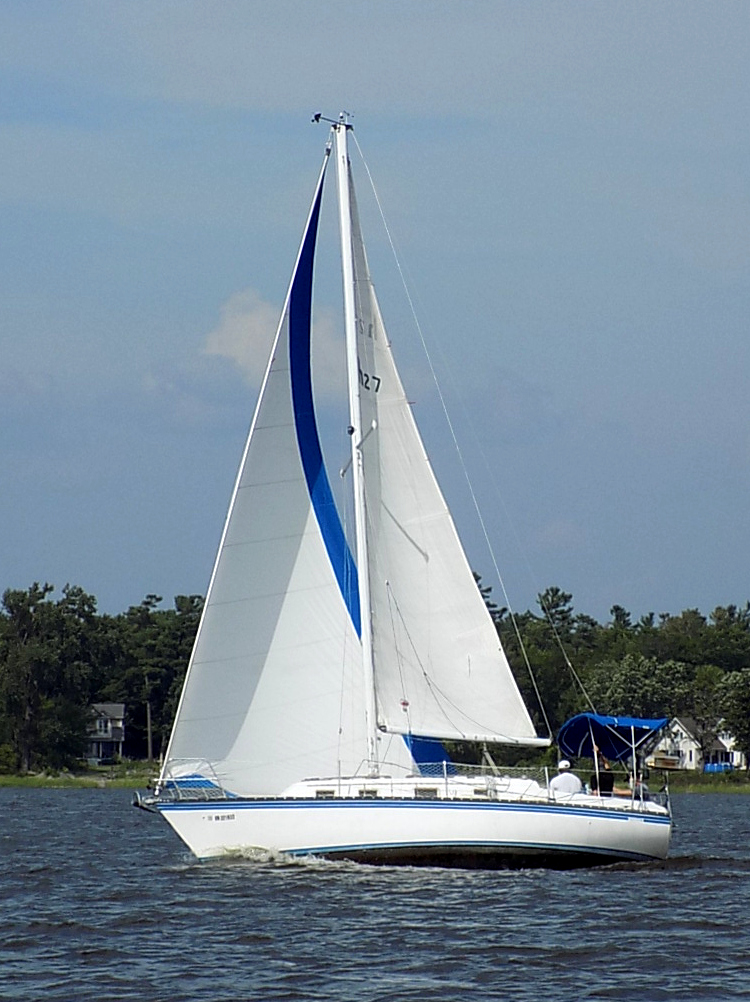
Designed as an affordable entry point into cruising sailboats, this 27-footer from Hunter Marine represents the builder's commitment to accessible sailing. The Hunter 27 appeals primarily to coastal cruisers and weekend sailors seeking a manageable boat that won't overwhelm novice crews or strain maintenance budgets. Built with Hunter's characteristic focus on interior volume and ease of handling, the boat features a roomy cabin that maximizes living space relative to its length. The cockpit is designed for comfortable day sailing, with straightforward sail controls that make single-handed operation feasible for experienced sailors. Like many boats in this size range from the era, the Hunter 27 strikes a balance between performance and comfort, though it leans decidedly toward the latter. The boat's moderate displacement and beam provide stability in typical coastal conditions while maintaining reasonable sailing characteristics in light to moderate winds. This model suits sailors looking for their first cruising boat or those downsizing from larger vessels. Its size makes it trailerable in many configurations, opening up cruising opportunities beyond a single home port. The Hunter 27 represents practical sailing for those prioritizing affordability and ease of use over racing performance.
About this estimate ▾
- Based on asking prices — not actual sale prices, which are typically lower.
- Condition, year, location, and included equipment are not factored in.
- Outliers are automatically excluded using statistical filtering.
- See our full analysis: What Thousands of Sailboat Listings Tell Us About Used Boat Prices.

No owner reviews yet — be the first to share your experience with this boat.
What's the difference between the Cherubini Hunter 27 and the 2008 Hunter 27?
There are actually three distinct boats called the Hunter 27, and they are not the same boat. The original Cherubini Hunter 27 (1975–1984, approximately 2,375 hulls) was designed by John Cherubini for Hunter Marine — a traditional-looking masthead sloop with a fractional-cruiser interior, standard Atomic 4 gasoline engine or optional Yanmar diesel, and the teak-trimmed interior typical of its era. A brief Hunter 27-3 variant (1984–1987) shared the Cherubini hull but used updated deck tooling. The Hunter 27 (2008–2013) is a completely different boat designed by Glenn Henderson — B&R rig with no backstay and swept-back spreaders, modern hull shape with an integral fin keel and lower sheer line, and a Yanmar 2YM15 diesel standard. When you see a Hunter 27 listed for sale, the first thing to verify is which era — a Cherubini-era boat and a 2008 boat have almost nothing in common except the length.
Is a Hunter 27 a bluewater boat?
No — neither the Cherubini Hunter 27 nor the 2008 Hunter 27 was designed for offshore passages. Both have Capsize Screening Formula values above 2.0, comfort ratios in the low 20s, and rigging, tankage, and hull-to-deck construction aimed at coastal cruising and lake or bay sailing. The Cherubini-era boat has the better reputation for handling a blow because of its heavier displacement and more traditional sheerline, but its wood-cored deck is a liability in bluewater conditions where constant wetness accelerates core rot. Both boats have crossed oceans in the hands of experienced sailors with heavy upgrade packages — storm sails, jackline attachments, upgraded chainplates, new standing rigging, additional tankage — but as stock boats off the used market they're best suited to coastal hops in settled weather, the Chesapeake, the Great Lakes, and the Intracoastal.
Where is the engine water pump on a Hunter 27?
It depends on which engine your boat has. On the Cherubini-era Hunter 27 with the Yanmar 1GM10 (the most common late-run configuration), the raw-water pump is on the front starboard side of the engine, accessed by removing the companionway steps to expose the engine's front face. The Yanmar fresh-water circulating pump sits above and slightly behind it. On earlier Cherubini Hunter 27s still running the original Atomic 4 gasoline engine (common on pre-1980 hulls that have not been repowered), the raw-water pump is belt-driven off the front of the engine block and uses a smaller Jabsco impeller with shorter service intervals. On the 2008-plus Hunter 27 with the Yanmar 2YM15, the raw-water pump is in the same front-starboard position as the 1GM but larger and easier to service — the engine itself is better sound-insulated, but the access path through the companionway is essentially the same.
How many Hunter 27s were built?
The Cherubini-era Hunter 27 (1975–1984) had approximately 2,375 hulls produced across its run, making it the second best-selling Cherubini-era Hunter behind the Hunter 25 and 25.5. Production numbers for the Hunter 27-3 variant (1984–1987) are sometimes folded into that figure and sometimes reported separately — most registries list it as roughly 300 additional hulls built during its three-year run. The 2008–2013 Hunter 27 had a much shorter production run and significantly lower annual volume — exact factory figures are not public, but hull-numbering suggests fewer than 500 boats total. That makes the 2008-era boat one of the less-common Hunter models on the used market today, despite being the newer of the two.
What are common problems to watch for on a used Hunter 27?
On the Cherubini-era Hunter 27 (1975–1984), the top three things to inspect are the balsa-cored deck (soft spots, especially around deck hardware and chainplates — expensive to repair properly), the hull-to-deck joint (mechanical fasteners that can loosen over decades and weep around stanchion bases), and the original fuel tank (steel, prone to rust-through after 30-plus years). On boats still running the original Atomic 4 gasoline engine, budget for either a repower or significant work on the carburetor, ignition, and fuel system. On the 2008-plus Hunter 27, the B&R rig is proprietary and replacement spreader hardware is harder to source — inspect the spreader tips, the mast step for corrosion, and the chainplate bedding on the first walkthrough. Both eras benefit enormously from a pre-purchase survey given the potential repair costs if you miss something structural.