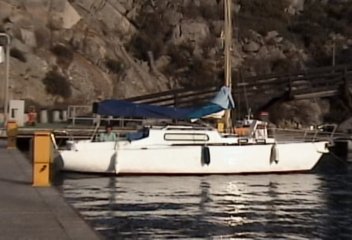
Swedish designer Per Brohall created one of Scandinavia's most successful small cruisers when he penned the Vega 27 in the mid-1960s. Built by Albin Marine from 1965 to 1979, this fiberglass masthead sloop found favor with 3,450 owners worldwide, establishing itself as a proven coastal cruiser and weekender. With its moderate proportions and fin keel configuration, the Vega 27 strikes a practical balance between performance and comfort. The 27-foot hull carries respectable beam at just over 8 feet, providing adequate interior volume while maintaining good sailing characteristics. At 5,070 pounds displacement with nearly 40% ballast ratio, she offers reassuring stability for coastal adventures. The boat's comfort ratio of 20 and capsize screening of 1.88 position her squarely in capable coastal cruising territory, while the sail area to displacement ratio of 16.09 suggests moderate performance under sail. Her 6.43-knot hull speed provides respectable passage-making ability for a boat this size. Known for solid construction and seaworthy handling, the Vega 27 appeals to sailors seeking a manageable cruiser with proven offshore genetics. The design's longevity and production numbers speak to its fundamental soundness as a small family cruiser.
No owner reviews yet — be the first to share your experience with this boat.
Why does my Albin Vega 27 have orange rust staining along the keel root, and how serious is it?
The Albin Vega 27 uses an encapsulated cast iron fin keel that is molded integrally into the fiberglass hull rather than bolted on as a separate unit. This design means there is no external keel joint to rebolt, but it creates a different and potentially serious problem: the cast iron inside the encapsulation corrodes over time, and as iron oxide expands it can crack the surrounding laminate from the inside out. Orange weeping stains along the keel root are the most common visible symptom. On a lightly affected boat, grinding back the gelcoat, treating the iron, and relaminating can arrest the damage. On a badly corroded example, the structural integrity of the keel-to-hull section may be compromised, which is a much more expensive repair. Any Vega 27 showing rust staining should be surveyed by a marine surveyor with specific experience in encapsulated-keel construction before purchase.
How many Albin Vega 27s were built and when did production end?
Albin Marine AB of Sweden built exactly 3,450 Vega 27 hulls over a production run that spanned fourteen years, from 1965 through 1979. Designed by Per Brohall in the mid-1960s, the Vega 27 became one of the most numerically successful small cruisers ever produced in Scandinavia. Production ended in 1979, meaning the youngest boats are now well over four decades old. The relatively large number of hulls built means that a reasonably active used market still exists, particularly in Northern Europe and in North America where the type was exported in meaningful numbers. The long production run also means that early and late boats can differ in detail fittings, interior trim, and deck hardware, so the build year matters when sourcing replacement parts.
What are the signs of balsa core rot in the Vega 27's deck and where should I probe first?
The Albin Vega 27 was built with a balsa-cored deck throughout its entire production run from 1965 to 1979, and virtually every boat of this age has experienced some degree of core saturation. The highest-risk locations are around the chainplate exit points on the side decks, stanchion base bolts, and any deck hardware that was through-bolted without proper sealing over the decades. A secondary concern specific to the Vega 27 is that the chainplates are glassed directly into the hull liner and pass up through the cored deck, creating a chronic leak path that saturates the adjacent balsa silently for years before soft spots become obvious underfoot. When inspecting a Vega 27, tap the entire side deck and coachroof systematically with a small mallet listening for the dull thud of wet core versus the crisp tap of sound laminate. Pay particular attention to the area within about six inches of every piece of deck hardware.
Which engine was fitted to most Vega 27s and are parts still available for it?
The majority of Albin Vega 27s left the factory fitted with either the Volvo Penta MD1 or MD2, both single-cylinder, raw-water-cooled or heat-exchanger-cooled small diesels that were common Swedish auxiliary choices of that era. These engines were already elderly by the time the Vega's production ended in 1979, so surviving examples are now approaching or exceeding sixty years of service. Parts availability has become genuinely difficult: heat exchangers corrode and are no longer catalogued by Volvo Penta, injector pumps wear and specialist rebuilders are thinning out, and gasket sets require sourcing from niche suppliers. When evaluating a Vega 27, insist on running the engine at full operating temperature and under load at the dock. Smoke, rough running, overheating, or an owner who is reluctant to demonstrate the engine are all red flags. Many owners have replaced the original unit with a modern Yanmar 1GM10 or Beta 14, which is often a sensible choice on a boat used regularly.
Does the Vega 27's mast partner area crack, and what causes it?
Yes, cracking and crazing around the mast partner on the coachroof is a well-documented and very common finding on the Albin Vega 27. The mast on the Vega 27 sits on a tabernacle and partner arrangement that passes compression loads directly into the coachroof laminate. Over the decades these repeated compression loads, combined with the flexing of an aging fiberglass structure, cause the gelcoat and sometimes the underlying laminate around the partner to crack in a star or spider-web pattern. In mild cases this is cosmetic, but deeper cracks can allow water into the coachroof core and signal that the laminate around the partner has been stressed beyond its design intent. A thorough inspection should include checking not just the visible gelcoat crazing but also the underside of the coachroof at the mast step below decks for delamination or soft spots. Reinforcing the partner area with additional glass cloth is a standard repair that many experienced Vega 27 owners have carried out.